How Visual Cues and Interface Design Affect Decision Patterns in Digital Card Games
Katja Powell · Oct 6, 2026
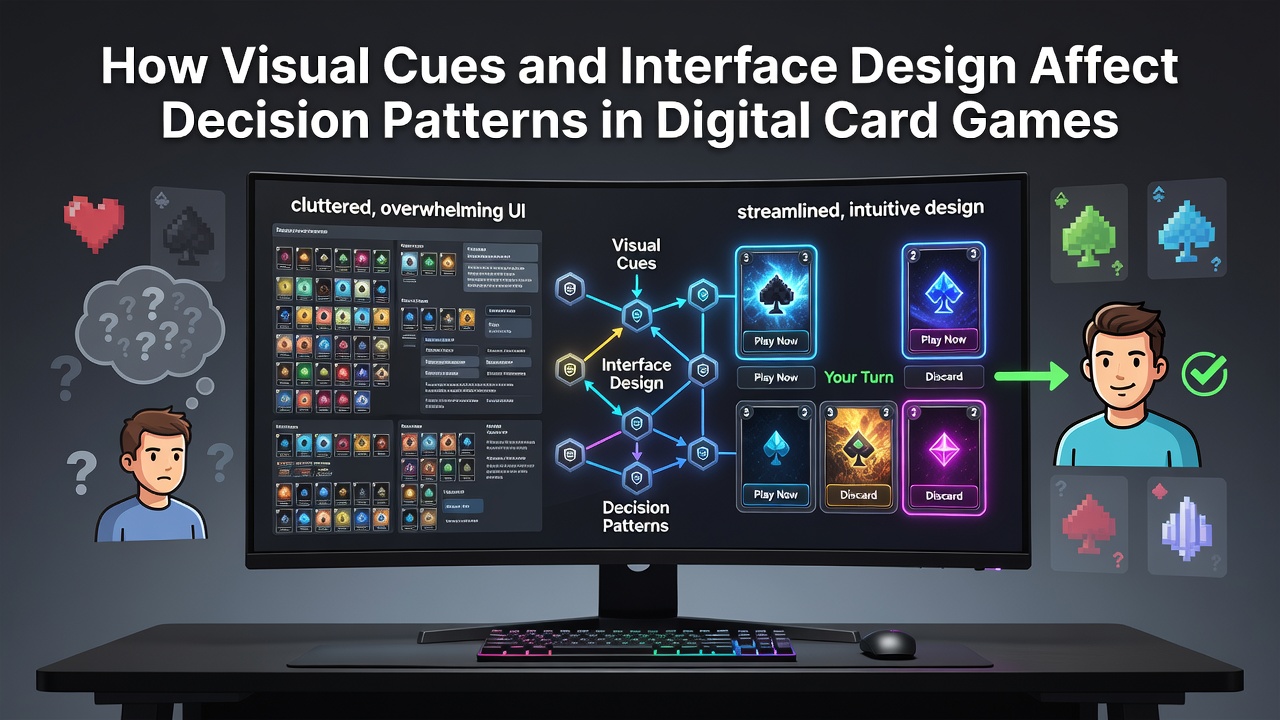
How Visual Cues and Interface Design Affect Decision Patterns in Digital Card Games
Digital card games rely on layered visual elements that guide player attention and shape choices during each round. Researchers have documented how color gradients on card backs, animated highlights around playable options, and spatial arrangement of decks influence the speed and type of decisions users make. Studies in human-computer interaction fields demonstrate that these cues operate through established principles of visual perception, where contrast draws focus and motion signals priority.
Core Visual Elements in Card Interfaces
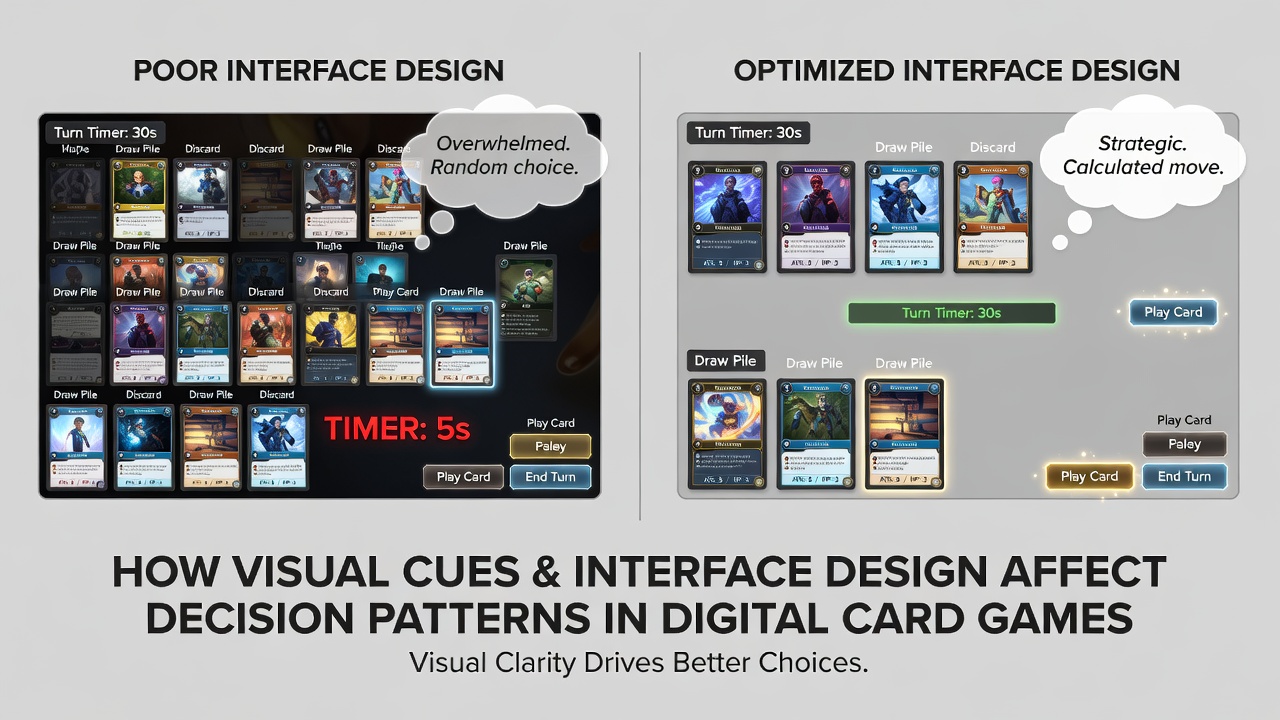
Card positioning on screen determines initial scanning patterns, with most interfaces placing the draw pile centrally and discard piles to the side. This layout encourages left-to-right reading habits common in Western users while directing eye movement toward action zones. Color coding for suits appears consistently across platforms, yet saturation levels vary and data from eye-tracking experiments shows higher saturation increases fixation duration on specific cards by measurable margins. Animations that pulse around valid moves activate when certain conditions meet, creating temporal cues that accelerate selection rates in timed rounds.
Interface designers incorporate feedback loops where selected cards enlarge slightly and emit subtle glows before confirmation. These micro-interactions reduce uncertainty during multi-card combinations and appear in multiple titles released through 2025. Observers note that such feedback correlates with fewer erroneous plays in competitive formats, according to aggregated user session logs analyzed by academic teams.
Impact on Decision Speed and Risk Assessment
Timing indicators displayed as progress bars or shrinking circles alter how players weigh options under pressure. Shorter countdown visuals prompt quicker selections even when strategic depth remains available, while extended timers paired with dimmed backgrounds allow longer deliberation. Research conducted at institutions in Canada tracked these patterns across thousands of sessions and found that bar-style timers produced 18 percent faster average response times compared to numeric countdowns alone.
Opacity changes on inactive cards direct focus toward active choices without removing information entirely. This technique appears in several major digital platforms and supports pattern recognition by reducing visual noise. Data collected through October 2026 indicates that platforms implementing graduated opacity report shifts in player retention metrics during extended play periods, though exact figures depend on game genre and user demographics.
Case Examples from Established Platforms
One widely studied example involves a popular digital rummy variant where suit-matching prompts appear as colored borders that intensify when combinations near completion. Players exposed to these borders completed valid sets at higher rates than control groups without the enhancement. Similar mechanisms operate in bridge simulation software, where trick-taking indicators use arrow overlays to suggest optimal leads based on prior play history.
Another instance comes from solitaire applications that employ shadow effects beneath foundation piles. These shadows grow more pronounced as cards approach correct placement, guiding incremental decisions without explicit instruction. European research groups have examined this approach and linked it to measurable changes in completion times across user cohorts.
Broader Design Patterns and User Adaptation
Button placement for actions such as draw, discard, and sort follows consistent ergonomic principles across devices. Larger touch targets positioned at thumb-reachable zones reduce physical effort and indirectly support continued engagement. When designers rearrange these elements, adaptation periods emerge during which decision accuracy temporarily declines before stabilizing at new baselines.
Sound cues often accompany visual signals, yet the visual channel dominates in silent play environments common on mobile devices. Cross-modal studies confirm that combined audio-visual prompts produce the strongest alignment between intended and actual player actions. Platforms released after mid-2025 increasingly separate these channels to accommodate varied usage contexts.
Accessibility features including high-contrast modes and simplified icon sets modify decision patterns for users with specific visual requirements. These adaptations maintain core mechanics while altering cue intensity, and testing data reveals comparable performance levels once users adjust to the modified displays.
Conclusion
Interface components in digital card games function as active participants in the decision process rather than passive containers. Evidence from multiple regions shows consistent relationships between specific visual treatments and measurable shifts in selection timing, error rates, and strategic focus. As platforms continue updating through 2026 and beyond, ongoing examination of these interactions provides clearer understanding of how design choices translate into observable player behavior across different game types and devices.