How Certification Protocols Shape Software Reliability Across Digital Table and Reel Games in Regulated British Platforms
Katja Powell · Aug 21, 2026

How Certification Protocols Shape Software Reliability Across Digital Table and Reel Games in Regulated British Platforms
Certification protocols establish structured testing frameworks that verify random number generators, game logic integrity, and payout accuracy in digital table and reel games offered on regulated British platforms, and these frameworks connect directly to measurable improvements in software stability because independent laboratories apply consistent benchmarks before any title reaches players.
Core Elements of Certification Testing
Independent laboratories examine source code, compile statistical data on random outcomes, and run millions of simulated spins or hands to confirm that reel games deliver returns within declared parameters while table games such as blackjack and roulette maintain correct probability distributions; the process relies on standards that cover both hardware random number generators and software algorithms, and researchers document each test result so operators can demonstrate compliance when platforms undergo periodic reviews.
Standards organisations publish detailed criteria that address everything from seed generation to game mathematics, and data from these evaluations shows that certified titles experience fewer discrepancies in payout reporting compared with uncertified equivalents, because the protocols force developers to correct anomalies before release rather than after player complaints surface.
Application to Digital Reel Games
Reel games undergo extended RNG cycles that test millions of combinations for uniformity, and certification bodies record variance statistics to ensure symbols appear according to programmed frequencies; this scrutiny extends to bonus features and progressive jackpots, where additional layers of verification confirm that triggers and prize pools operate without external manipulation.
Platforms integrate these certified reel titles into live environments, and ongoing monitoring requirements mean that any software update must pass re-testing before deployment, which prevents incremental changes from introducing new reliability issues over time.
Application to Digital Table Games
Table games receive parallel yet distinct evaluation because they combine random elements with rule-based decision trees, and laboratories simulate both automated dealer actions and player strategy inputs to verify that house edges remain constant across all possible decisions; certification also checks network latency handling and multi-player synchronisation so that simultaneous sessions do not produce inconsistent results.
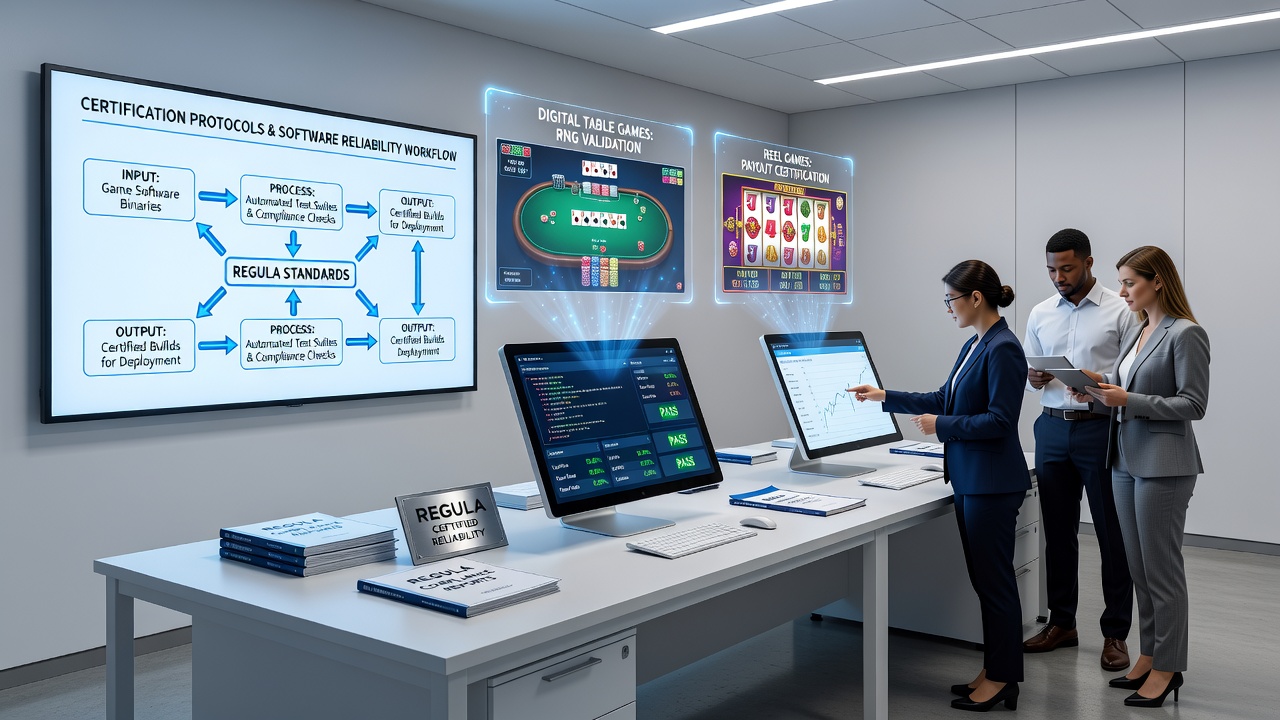
Those who analyse post-certification performance data note that table game software exhibits reduced crash rates and faster recovery times after connectivity interruptions, because the testing process includes stress scenarios that replicate peak-hour loads on British platforms.
Regulatory Integration and Platform Requirements
British platforms must maintain records showing that every title carries current certification, and regulators cross-reference these records during audits to confirm that reliability metrics align with documented test outcomes; this linkage creates a feedback loop where operators share incident reports that feed back into protocol refinements at the laboratory level.
By August 2026, several certification frameworks are scheduled to incorporate enhanced requirements for cloud-based game instances, and early documentation indicates these updates will expand test coverage for virtual machine integrity and containerised deployments without altering existing statistical thresholds.
Impact on Overall Software Reliability Metrics
Longitudinal studies compiled by industry research groups demonstrate that platforms using only certified software record lower rates of disputed transactions, and the same datasets reveal quicker resolution times when anomalies do occur because certification provides a documented baseline against which live results can be compared.
Developers who submit titles for certification often discover latent coding issues during the review cycle, and addressing those issues before launch reduces downstream maintenance costs while improving player trust in the stability of both table and reel products.
Conclusion
Certification protocols function as the primary mechanism that translates regulatory expectations into concrete software performance standards across digital table and reel games on regulated British platforms, and the combination of pre-release testing, statistical validation, and continuous monitoring produces measurable gains in reliability that operators and laboratories track through shared data systems.